

Spiritual Meaning of Black Tourmaline, Explained
In spiritual tradition, black tourmaline symbolizes protection, grounding, and the cleansing of heavy or negative energy. These are traditional beliefs and personal interpretations, not demonstrated physical effects.
You may be holding a dark, ridged stone or browsing a bracelet labeled protection stone, wondering what you're being offered. Is protection a feeling, a spiritual practice, or a claim that the mineral can shield your body? That distinction matters, especially when meaningful symbolism appears beside promises about health or electronics.
Table of Contents
- The Spiritual Meaning of Black Tourmaline
- Where the Symbolism of Black Tourmaline Began
- The Core Spiritual Associations of Black Tourmaline
- The Physical Properties Behind the Metaphors
- Separating Spiritual Meaning From Testable Claims
- Everyday Ways to Use Black Tourmaline in Spiritual Practice
- Taking the Next Step With Black Tourmaline
The Spiritual Meaning of Black Tourmaline
A protection label can mean different things to different shoppers. Someone buying jewelry after a difficult period might want a reminder to maintain personal boundaries. Someone else might interpret the same label as a promise that the stone will intercept an invisible threat.
The spiritual meaning of black tourmaline is most useful when you know which interpretation you're choosing. You can respect the stone's symbolism without treating every description of its powers as a factual statement.
Meaning Is Different From Mechanism
Consider a familiar, hypothetical situation: you put on a black tourmaline bracelet before a demanding conversation. You decide that noticing it will remind you to pause rather than agree to something you don't want to do.
That's a specific use of symbolism. You've connected an object with an intention and a behavior. Claiming that the bracelet automatically prevents another person's negativity from reaching you would be a different proposition, one that requires evidence beyond personal meaning.
A useful distinction: Ask whether a description tells you what the stone represents or promises what the stone physically does.
You don't have to choose between appreciating the mineral and enjoying its spiritual associations. Looking closely at an actual specimen can make that appreciation more concrete. Astro West's listing of feldspar with fluorite and hyalite opal offers a mineral-focused reference alongside the jewelry descriptions you may encounter.
A More Precise Way to Read Spiritual Language
When evaluating a description, separate these questions:
- Identity: What mineral is being sold, and how is it identified?
- Association: What meaning does the seller or practitioner attach to it?
- Promise: Does the wording imply a measurable result?
Those questions let you remain curious without surrendering judgment. A description can be personally resonant yet scientifically unproven. Equally, a beautiful specimen doesn't need supernatural powers to deserve your interest.
The most honest approach leaves room for both wonder and precision. You can admire what a stone is, choose what it means to you, and decline claims that go further than the evidence.
Where the Symbolism of Black Tourmaline Began
The documented story begins with a mineral name, not a verified account of spiritual protection. Black tourmaline is commonly identified as schorl, an iron-rich, opaque member of the tourmaline group.
The name was associated with a mining settlement in Saxony before 1400, near what is now Zschorlau, where black tourmaline occurred alongside tin mining. Johannes Mathesius later described the mineral as schürl in 1562, in his account of the Ore Mountains, according to the historical record of schorl.
What the Mining Record Establishes
This history places black tourmaline within a recognizable European mining context. People encountered it as material in the ground, distinguished it from surrounding minerals, and gave it a name.
It doesn't establish that those miners practiced today's protection rituals. A mineral's documented identity and the documented age of a spiritual belief are separate historical questions.
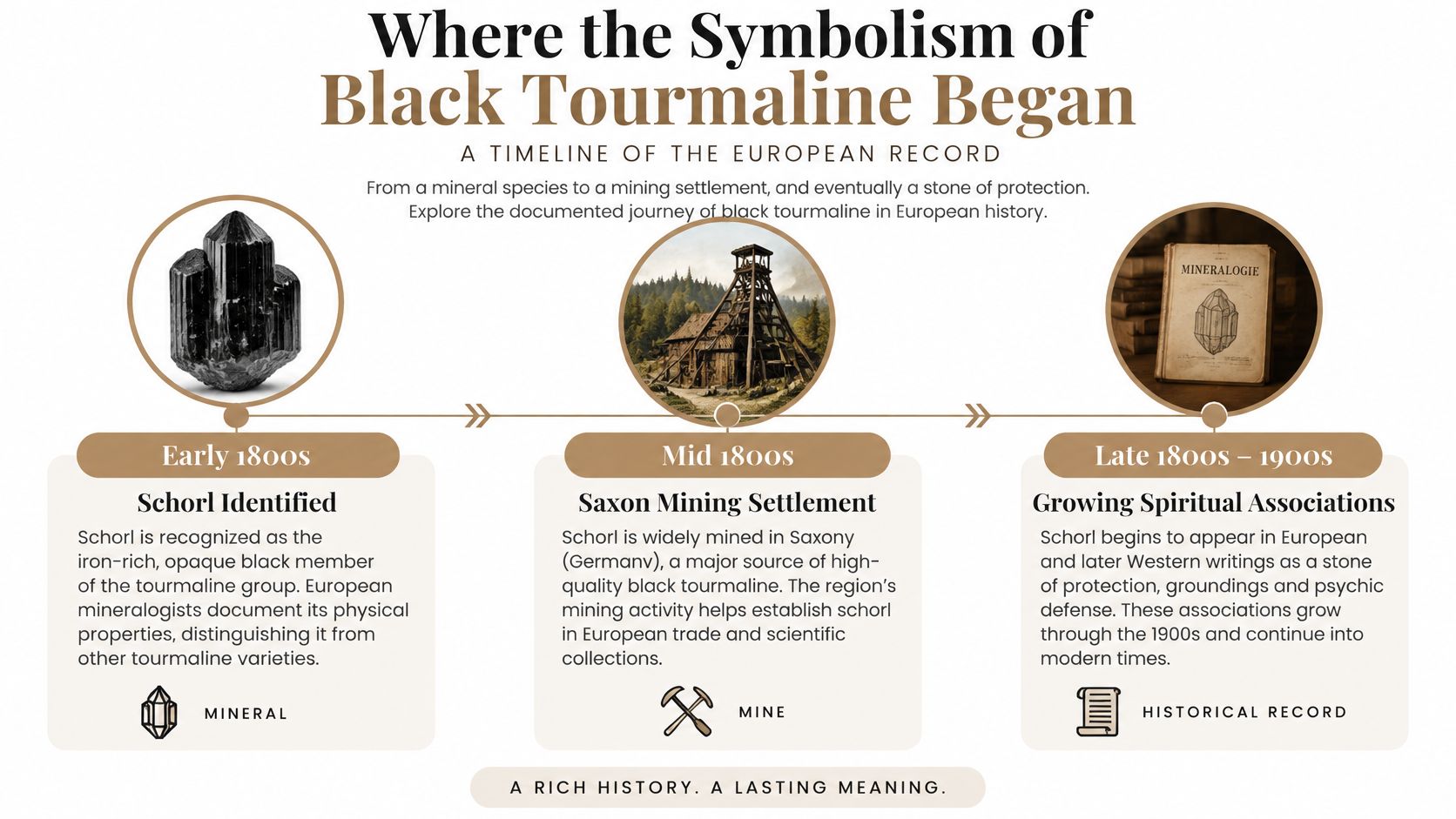
The difference is easy to miss when a product description calls a stone ancient. The material may have a long recorded history, while a particular interpretation belongs to a later spiritual practice. Without evidence connecting them, we shouldn't turn mineralogical dates into dates for ritual traditions.
How Material Becomes Symbol
Black tourmaline's appearance and physical character offer understandable starting points for later symbolism. Its dark color can suggest shelter or enclosure; its solid presence can invite thoughts of steadiness. These are interpretations of observable qualities, not evidence that the mineral performs the actions people associate with them.
Keeping the categories separate helps preserve the history:
- Documented record: Names, mining locations, descriptions, and physical observations.
- Spiritual interpretation: Meanings people attach to those qualities.
- Unverified extension: Claims that a modern ritual was practiced continuously since the earliest mineral record.
A similar care with context is useful when exploring other protective objects, including the meaning of a red string bracelet. Objects can carry significant meaning without sharing the same origin or belonging to a single universal tradition.
Black tourmaline doesn't need an embellished past. Its actual mineral history is interesting enough, and its modern symbolism can be discussed on its own terms.
The Core Spiritual Associations of Black Tourmaline
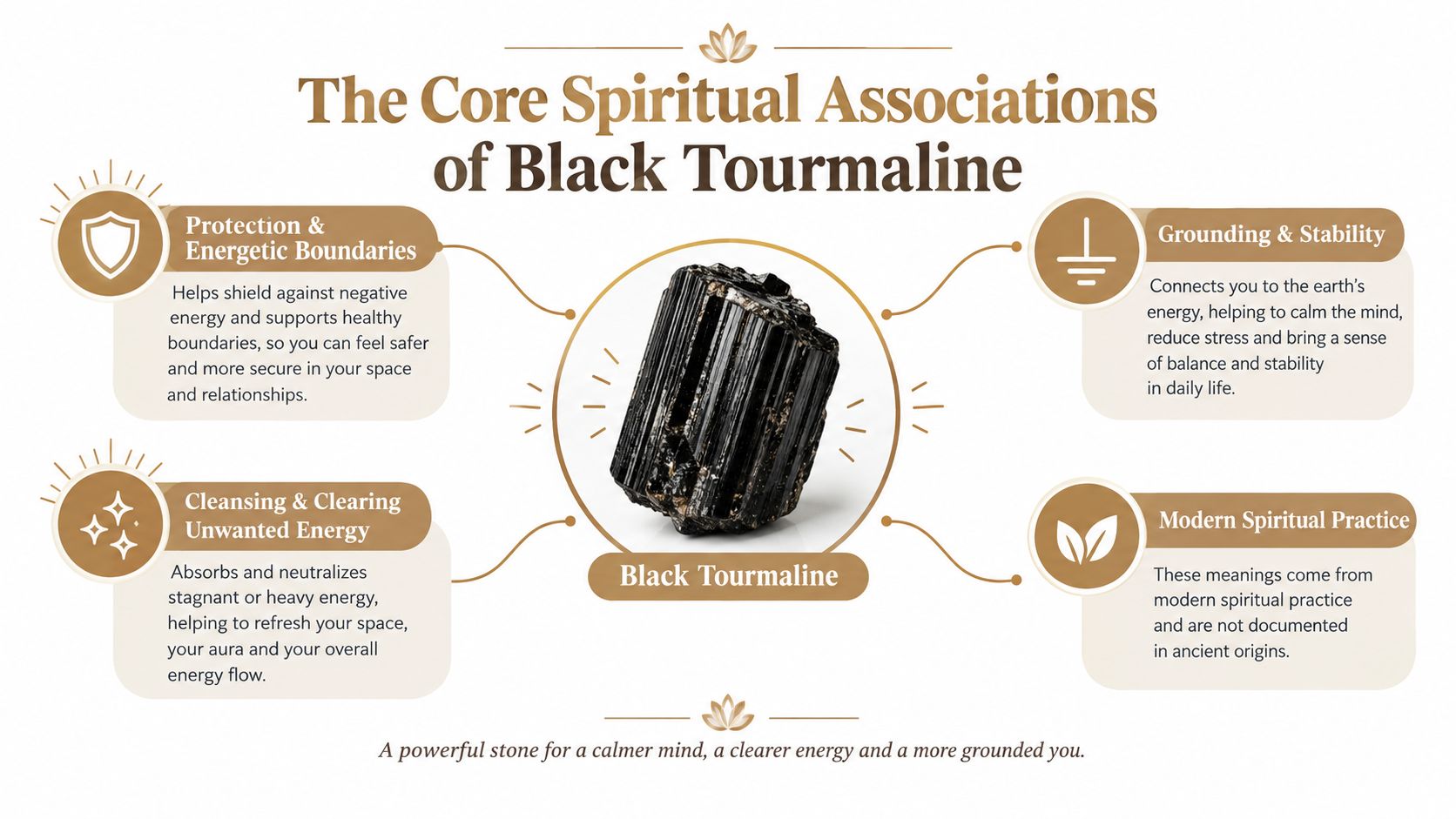
Protection, grounding, and purification form a connected symbolic language. Rather than treating them as unrelated powers, consider them as different ways of expressing a desire for greater steadiness.
Black tourmaline typically has a Mohs hardness of approximately 7–7.5, and its black appearance results largely from iron in its structure. Modern spiritual interpretations connect these qualities with resilience and shielding, as described in this overview of black tourmaline's properties and symbolism.
Protection and Grounding
In spiritual language, protection often means maintaining a boundary between what you choose to engage with and what you don't. The dark stone becomes a visual emblem of that boundary. This interpretation is different from saying its color physically absorbs harmful influences.
Grounding expresses a related intention: remaining present rather than feeling pulled in every direction. In chakra-oriented practice, people may connect this theme with the root chakra, understood within that spiritual framework as a foundation of stability.
For a broader discussion of that vocabulary, the guide to crystals, grounding, and the Earth element across traditions offers another point of entry. Treat those connections as interpretive frameworks rather than mineralogical classifications.
A practical translation makes the distinction clearer:
- Protection: Decide which requests, conversations, or demands you'll accept.
- Grounding: Return attention to your immediate surroundings and your next manageable action.
- Purification: Reflect on what you want to stop carrying into the rest of your day.
Purification Without Self-Judgment
Traditional purification language can include releasing anger, anxious thoughts, or feelings of unworthiness. Read this as a description of spiritual intention, not a claim that a crystal extracts emotions from the body.
It also shouldn't imply that difficult feelings make you contaminated. Anger may require attention, anxiety may require care, and repetitive thoughts may call for professional support rather than a more elaborate cleansing ritual.
The coherent theme is deliberate choice. Protection concerns what you let in, grounding concerns where you place your attention, and purification concerns what you're ready to reconsider or release. You can work with those meanings without labeling normal human emotions as dangerous energy.
The Physical Properties Behind the Metaphors
Tourmaline's electrical behavior is real. The mistake is assuming that any material with electrical properties must therefore protect a person from unwanted energy.
Tourmaline is a borosilicate mineral, meaning its chemistry includes boron and silicate components. Its crystal structure is non-centrosymmetric, a technical way of saying its internal arrangement lacks a center of symmetry, and it has spontaneous electrical polarization. The relevant material science is discussed in this research chapter on tourmaline's electrical properties.
Translating the Electrical Terms
The terminology becomes less mysterious when you separate the stimulus from the response:
- Pyroelectricity: A temperature change can produce an electrical response in the crystal.
- Piezoelectricity: Mechanical pressure can produce an electrical response.
- Polarization: Positive and negative electrical charge are arranged unevenly within the material.
These responses depend on crystal chemistry, orientation, temperature change, and mechanical stress. They aren't a constant, general-purpose protective force. Warming a bead in your hand doesn't turn it into a personal electromagnetic shield.
An everyday comparison is a rubbed balloon attracting stray hairs. You can observe an electrical effect without concluding that the balloon cleanses emotions or protects someone's health. The comparison illustrates the reasoning limit, not an identical physical mechanism.
Why the Scientific Words Can Mislead
Words such as electrical, energy, and frequency sound precise, but they lose that precision when people use them interchangeably. In material science, an electrical response has specific conditions and measurable characteristics. In spiritual conversation, energy may describe someone's mood, attention, or sense of atmosphere.
Neither use licenses a jump between the categories. If a person says a room feels heavy, they may be describing an experience. Demonstrating a crystal's response to pressure doesn't establish that it can remove that experience from the room.
A genuine physical property can inspire a metaphor without proving the metaphor literally true.
For jewelry, the sensible conclusion is narrow: tourmaline is an interesting material with conditional electrical behavior. Its measurable properties explain part of its fascination, but they don't establish aura cleansing, psychic shielding, or a protective field around the wearer.
Separating Spiritual Meaning From Testable Claims
A black tourmaline stone beside a laptop can be a meaningful desk object. A claim that it protects your health from the laptop's emissions is something else entirely.
There's no established evidence that wearing black tourmaline or placing it near electronics protects health. Mineral characteristics and electrical responses don't demonstrate protection of the human body, a distinction emphasized by the material-focused context in this New Mexico mineral museum reference.
Symbolic Meaning vs Testable Claims for Black Tourmaline
| Claim | Type of Claim | What Supports It | How to Treat It |
|---|---|---|---|
| The stone represents personal protection | Spiritual association | Traditional and personal interpretation | Choose it if the symbolism resonates |
| Touching it reminds me to pause | Symbolic use | A personally chosen connection between object and action | Judge whether the reminder is useful |
| It cleanses an aura | Metaphysical belief | Spiritual interpretation, not an established measurable effect | Identify it clearly as belief |
| It blocks Wi-Fi or EMF exposure | Testable physical promise | No established protective effect in wearable or nearby use | Don't rely on it as shielding |
| It prevents illness or treats anxiety | Health claim | No established therapeutic effect of the stone itself | Keep medical and psychological care separate |
The important question isn't whether a description sounds spiritual. It's whether a reasonable buyer could understand it as a safety promise. Saying that a necklace is associated with protection differs substantially from telling someone they're protected while wearing it.
Matching Evidence to the Promise
A testable claim needs evidence that measures the claimed outcome under relevant conditions. Showing that tourmaline responds electrically to pressure doesn't answer whether a pendant reduces exposure, much less whether it improves health.
The same care applies to emotional wellbeing. If you're exploring crystals and anxiety-related calming practices, distinguish a comforting ritual from treatment for an anxiety disorder. Personal comfort matters, but it doesn't establish a medical effect.
Keep following appropriate public-health guidance and established safety advice. If you prefer less device use, make changes to your habits rather than assuming a nearby stone changes your exposure.
You can still enjoy black tourmaline on your desk. Let it remind you to stop scrolling, take a break, or close work at an agreed time. Those are identifiable actions you can evaluate, without relying on an invisible shield.
Everyday Ways to Use Black Tourmaline in Spiritual Practice
Start with a practice you can describe plainly. Hold the stone during meditation and name an intention, wear it as a reminder, or place it somewhere you'll notice before a reflective pause.
A controlled crystal-healing experiment involving 80 volunteers reported sensations or perceived changes in 74 participants using genuine or imitation crystals. The findings were interpreted as consistent with expectancy or placebo mechanisms rather than a unique crystal property, as discussed in this account of crystal-healing evidence.
Give the Object a Clear Job
You don't need to manufacture a dramatic experience. Instead, connect the object with an ordinary action:
- During meditation: Hold it while naming a specific intention, such as responding thoughtfully to a difficult request.
- As jewelry: Let noticing it prompt a brief check-in about your limits.
- In a room: Place it beside a journal as an invitation to reflect, not as a claim that it purifies the space.
- During a closing ritual: Acknowledge something you're finished with for the day.
If cleansing rituals interest you, Aroma Warehouse's guide to cleansing crystals is a resource for exploring that ritual vocabulary. Treat cleansing as a symbolic practice, not a demonstrated requirement for restoring a stone's powers.
Choose for Material, Comfort, and Meaning
For a wearable option, the Kailash Way Black Tourmaline Purification Protection Necklace is cataloged as natural black tourmaline. Its purification and protection language describes the spiritual associations attached to the piece, not verified protective performance.
The product presentation shows how those intentions appear in a jewelry setting.
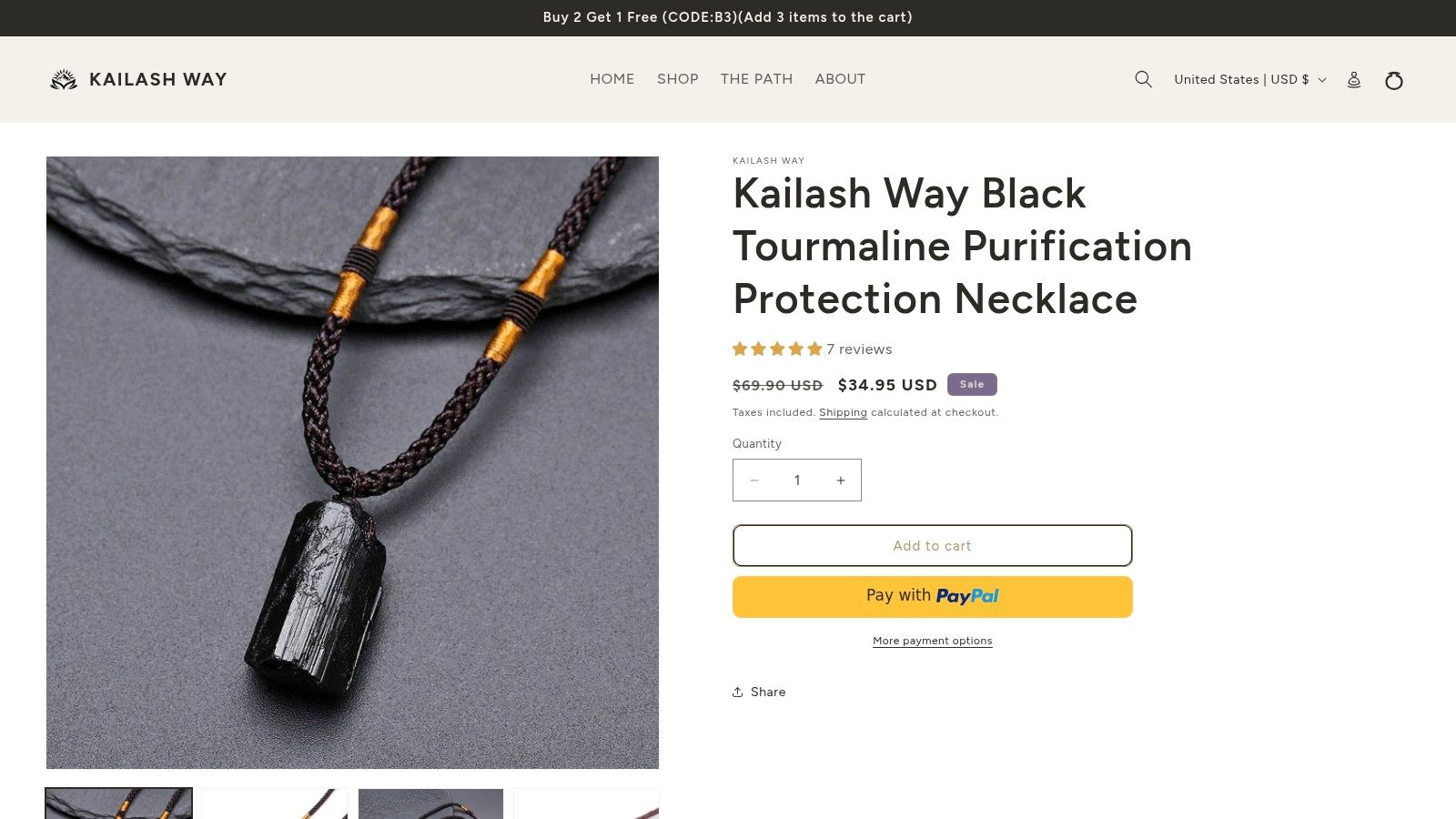
Compare any necklace with a loose specimen or pocket stone according to how you'll use it. Ask about material identification, inspect construction, and consider comfort and personal resonance.
Shopping rule: Pay for the material, workmanship, and meaning you value, not an unsupported promise of protection.
A meaningful practice doesn't require the most elaborate object. It requires a connection you understand and an action you're willing to repeat.
Taking the Next Step With Black Tourmaline
You don't have to settle every spiritual question before deciding whether black tourmaline belongs in your life. You do need to know what you're asking of it.
Its mineral history, symbolic associations, and physical behavior belong to related but distinct conversations. Respecting those distinctions lets you appreciate the stone without turning personal belief into a claim about everyone's body or safety.
Choose an Intention You Can Act On
Pick the association that feels most relevant: protection, grounding, or release. Then turn it into something you can do.
Protection might mean declining an unnecessary commitment. Grounding might mean paying attention to your surroundings before opening your messages. Release might mean writing down an unresolved concern and deciding when you'll return to it.
Try this simple ritual during the coming week:
- Choose a moment: Attach the practice to an existing habit, such as getting dressed or ending work.
- Name your intention: Use ordinary words that describe a choice within your control.
- Take the action: Follow the reminder with the behavior you selected.
- Notice your experience: Reflect on attention, mood, and follow-through rather than searching for proof of an altered aura.
Keep What's Useful
If the stone helps you remember your intention, that's a reasonable reason to keep using it. If you feel nothing unusual, you haven't failed, and the stone doesn't need to be blamed or spiritually repaired.
You can adjust the practice or enjoy the mineral as jewelry. There's no need to interpret every difficult day as evidence that it has absorbed too much negativity.
The most grounded next step is modest: select a meaning, connect it with a deliberate action, and observe your experience. Let the object support a choice, not replace one.
Kailash Way offers handcrafted, Tibetan-inspired spiritual jewelry organized around intentions such as protection. Visit Kailash Way to explore pieces that fit your personal symbolism, and choose one for its material, comfort, and role in a reflective daily practice.